
Views: 222 Author: Lake Publish Time: 2026-01-30 Origin: Site


Content Menu
● The Importance of Correct Blade Sizing
>> Clinical Impact of Improper Sizing
>> Standardization and Variation in Sizing Systems
● Anatomical Landmarks and Estimative Measurement Techniques
>> The External Jaw Measurement (The "Blade-to-Chin" Method)
>> Internal Anatomic Correlates and Blade Function
● Patient-Specific Factors in Blade Selection
>> Age and Developmental Stage
>> Anatomical Variations and the "Difficult Airway" Predictors
● Step-by-Step Procedural Measurement and Selection
>> Pre-Intubation Assessment and Planning
>> The Dynamic "Measurement-in-Use" Technique
>> Special Case: Measuring for Video Laryngoscope Blades
● Sizing Systems for Different Blade Types
>> Other Specialized Blades (e.g., McCoy, D-Blade)
● Documentation and Communication
● Training and Competency in Blade Selection
● Frequently Asked Questions (FAQ)
>> 1. What is the most common laryngoscope blade size used for an average adult?
>> 2. How do I choose between a Macintosh (curved) and a Miller (straight) blade?
>> 3. Can I use a pediatric laryngoscope blade on an adult patient?
>> 4. How does blade sizing work for disposable vs. reusable laryngoscopes?
>> 5. What should I do if the first laryngoscope blade size I choose doesn't provide a good view?
Selecting the correct laryngoscope blade size is a critical, yet often overlooked, component of successful and safe endotracheal intubation. An improperly sized blade—whether too large or too small—can lead to inadequate glottic visualization, traumatic airway injury, dental damage, and failed intubation attempts. Unlike a one-size-fits-all approach, the process of measuring and selecting a laryngoscope blade involves a nuanced understanding of patient anatomy, blade design characteristics, and clinical context. This comprehensive guide explores the systematic methods for determining the appropriate laryngoscope blade size, delving into measurement techniques, anatomical correlates, and the practical implications of blade choice for both direct and video laryngoscopy.

The laryngoscope blade serves as the mechanical interface between the operator and the patient's airway. Its size directly affects the procedure's mechanics:
- An Oversized Blade: A blade that is too long can cause trauma to the vallecula, epiglottis, or pharyngeal wall. It may also impinge on the arytenoid cartilages or vocal cords directly. It can make it difficult to achieve the correct angle within the mouth, potentially levering against the upper teeth and increasing the risk of dental injury. In pediatric patients, an oversized blade is particularly dangerous.
- An Undersized Blade: A blade that is too short may fail to reach the vallecula or adequately lift the epiglottis. This results in a poor or nonexistent view of the glottis, as the tongue is not sufficiently displaced. The operator may be forced to over-insert the blade, jamming it into the upper esophageal inlet, or apply excessive lifting force in an attempt to compensate, which is inefficient and traumatic.
Correct sizing optimizes the mechanical advantage of the laryngoscope, allowing for effective tissue displacement with minimal force, thereby maximizing the view and minimizing complications.
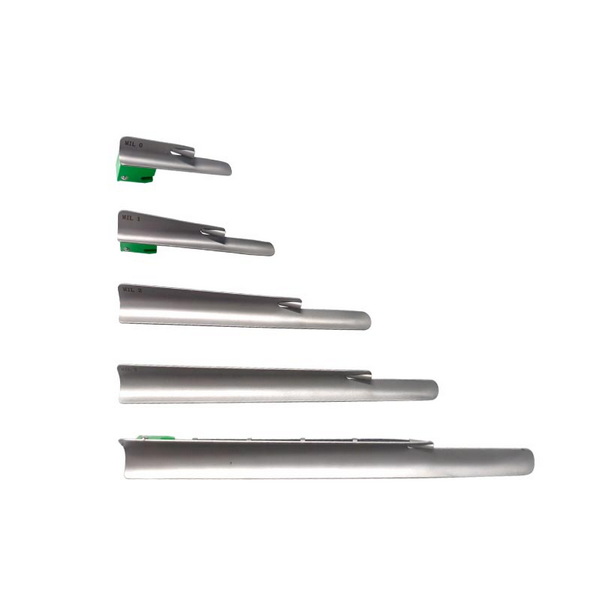
Laryngoscope blades are traditionally sized by a numerical system (e.g., Macintosh sizes 1, 2, 3, 4; Miller sizes 0, 1, 2, 3) that generally corresponds to increasing length and sometimes flange height. However, there is no universal standard for what these numbers represent in exact centimeters or inches across different manufacturers. A Macintosh 3 blade from one company may have slightly different dimensions than a Macintosh 3 from another. This underscores that the size number is a guide, not an absolute, and visual inspection of the blade against the patient or using anatomic landmarks is often more reliable than relying solely on the printed number.
A classic and rapid bedside estimation technique involves comparing the laryngoscope blade to the patient's external anatomy:
1. Procedure: With the patient's head in a neutral position, place the laryngoscope blade alongside the patient's face.
2. Landmark Correlation: The tip of the blade should reach from the patient's lips to the angle of the mandible (the jawbone's corner) or, alternatively, from the incisor teeth to the thyroid cartilage notch (the Adam's apple). A blade approximating this length is generally appropriate for orotracheal intubation.
3. Rationale: This rough measurement correlates blade length with the distance from the mouth's entrance to the laryngeal inlet. It is a quick, pre-procedure check, especially useful in emergency settings or when multiple blade sizes are available.
The true measure of a blade's suitability is how it relates to internal anatomy during use. The key functional measurements are:
- Reach to the Vallecula (Macintosh Blade): For a curved Macintosh blade, the correct size allows the tip to sit securely in the vallecula—the space between the base of the tongue and the epiglottis. A properly sized blade will not overshoot into the epiglottis or fall short.
- Reach beneath the Epiglottis (Miller Blade): For a straight Miller blade, the correct length allows the tip to pass under and directly lift the epiglottis without contacting the vocal cords.
- Flange Height and Tongue Control: The vertical height of the blade's flange must be sufficient to contain and displace the tongue to the left effectively. A flange that is too low will allow the tongue to bulge back into the line of sight.
Pediatric blade selection is highly precise and is primarily based on patient age and weight, moving into anatomical estimation as children grow.
- Neonates and Infants: Selection is critical. Straight blades (Miller or Wisconsin style) are often preferred due to the large, floppy epiglottis and anterior larynx. Typical sizing:
- Premature newborn: Miller 0
- Full-term newborn to 6 months: Miller 1
- 6 months to 2 years: Miller 1.5 or Macintosh 1
- Children: As children grow, estimation using the external jaw method becomes applicable. A general rule: a blade that reaches from the lips to the angle of the mandible or the tragus of the ear is often suitable.
- Adults: The Macintosh 3 blade is the most commonly used for average-sized adult females, and the Macintosh 4 for average-sized adult males. The Macintosh 2 may be suitable for smaller adults.
Certain anatomical features necessitate deliberate blade size selection:
- Protruding Incisors / "Overbite": May require a longer blade (e.g., Macintosh 4 instead of 3) to compensate for the increased anterior distance to the larynx, or the use of a blade with a different curve.
- Receding Mandible / "Short Neck": Often associated with an anterior larynx. A longer blade or a straight blade (Miller) may provide better control of the epiglottis and reach. This is a classic scenario where a video laryngoscope with a hyperangulated blade, which is sized differently, may be a better choice.
- Large Tongue or Obesity: May require a blade with a taller, broader flange (often a Macintosh 4 or a specialized blade) to effectively contain and displace the increased soft tissue mass.
- Limited Mouth Opening: May necessitate a smaller blade (shorter or narrower) to permit insertion, even if a longer blade would be ideal for reach. A pediatric-sized blade is sometimes used in adults with severe trismus.

1. Visual Inspection of Available Blades: Before approaching the patient, inspect the available laryngoscope blades. Note the size numbers and physically compare the lengths and flange heights of a Macintosh 3 versus a 4, for example.
2. Patient Assessment: Perform a rapid airway assessment (e.g., Mallampati score, thyromental distance, mouth opening). Mentally correlate findings with potential blade needs.
3. Primary and Backup Selection: Based on your assessment, select a primary blade. Always have at least one alternative size and style (e.g., a Macintosh and a Miller) immediately available. The first choice may not be correct upon direct visualization.
The most accurate measurement occurs during the procedure itself. The blade is measured against the patient's anatomy in real-time:
1. Initial Insertion: Insert your primary blade choice. If using a Macintosh blade, the goal is to place the tip in the vallecula.
2. Tactile and Visual Feedback:
- If you cannot see the epiglottis and the blade feels "lost" or too short, you likely need a longer blade.
- If you are seeing the posterior cartilages (arytenoids) or the esophagus, and the blade feels jammed or is causing trauma, you may have a blade that is too long.
- If the tongue persistently obscures the view from the right side, you may need a blade with a taller flange.
3. Immediate Correction: Do not persist with a poorly sized blade. Withdraw, select your alternative, and re-attempt. This dynamic adjustment is a sign of experienced technique, not failure.
The measurement principles for video laryngoscope blades share similarities but have key differences:
- Hyperangulated Blades: These are not measured by the same "lip-to-mandible" rule. Their length is often shorter, but their extreme curvature is designed to navigate around the tongue. Selection is based more on manufacturer guidelines for patient size (e.g., small, regular, large) and less on external anatomical measurement. The key is that the camera tip must be positioned to provide a view of the glottis, which may require less deep insertion than a Macintosh blade.
- Channeled Blades: The blade size must accommodate both the anatomic fit and the pre-loaded endotracheal tube. An undersized channeled blade may make tube passage difficult or impossible.
- Screen Feedback: The video laryngoscope screen provides immediate visual confirmation of blade tip position, making the "measurement-in-use" technique highly effective. If the camera tip is buried in mucosa or seeing only the tongue, the blade may need repositioning or a different size.
- Size 1: Infant/Toddler
- Size 2: Child/Small Adult
- Size 3: Average Adult (most common for females)
- Size 4: Large Adult (most common for males)
- Size 5: Very Large Adult
- Size 0: Premature/Newborn
- Size 1: Infant
- Size 2: Child/Small Adult
- Size 3: Standard Adult
- Size 4: Large Adult
Sizing is often unique to the design and follows the manufacturer's specific guidelines, typically categorized as Small, Medium, and Large equivalents.
Documenting the laryngoscope blade size used is a best practice. In the anesthesia record or procedure note, an entry such as "Intubated with Macintosh 3 blade, grade I view" provides valuable information for future encounters. During handoffs in critical care or the operating room, communicating the blade size that provided the best view can assist colleagues if re-intubation is needed.
Developing proficiency requires moving beyond memorized charts:
- Hands-on Comparison: Trainees should physically hold and compare different blades to understand dimensional differences.
- Manikin Practice with Varied Sizes: Deliberately using the wrong size on a manikin demonstrates the poor views and mechanical challenges that result.
- Supervised Clinical Exposure: There is no substitute for selecting blades for a variety of real patients—small, large, young, old—under supervision.
- Interdisciplinary Discussion: Learning from colleagues in anesthesia, emergency medicine, and critical care about their sizing strategies for challenging airways.
Measuring a laryngoscope blade for use is a dynamic clinical skill that blends simple external estimation with sophisticated internal anatomic correlation. It begins with a pre-procedure assessment and an understanding of standardized sizing charts but is ultimately confirmed and refined during the act of laryngoscopy itself through tactile and visual feedback. The correct blade size is the one that fits the patient's unique anatomy, allowing for effective tissue displacement and optimal visualization with the least force. In an era of advanced video laryngoscopy, the principles of appropriate sizing remain vital, even as the geometry of the blades evolves. Mastery of this skill—knowing not just how to hold the laryngoscope, but how to choose its working end—is fundamental to safe, efficient, and successful airway management. By prioritizing deliberate blade selection and being prepared to adapt, clinicians turn the laryngoscope from a generic tool into a precision instrument tailored for each patient.
Contact us to get more information!
For an average adult, the Macintosh (curved) blade size 3 is the most commonly used for women, and size 4 for men. The Macintosh 3 blade typically provides the correct length and flange height to effectively reach the vallecula and control the tongue in a majority of patients. However, "average" is a guideline, not a rule. Always have the adjacent sizes (2 and 4) immediately available, as anatomical variation is frequent.
The choice is based on patient anatomy, clinical scenario, and operator preference. Macintosh blades are often preferred for adults as they indirectly lift the epiglottis via the vallecula, which many find provides a broader view and is less traumatic to the epiglottis. Miller blades are often preferred in pediatric patients (due to the large, floppy epiglottis) and in adults with an anterior larynx or a long, floppy epiglottis where direct lifting may be more effective. In difficult airways, having both types available is considered standard preparation.
Yes, in specific circumstances. A smaller blade (e.g., Macintosh 2 or Miller 2) can be very useful in adult patients with limited mouth opening (trismus), prominent upper teeth, or a very small mandibular space. While it may not provide the ideal reach for a standard airway, it may be the only blade that can be inserted safely. Its use requires an understanding that a more anterior laryngoscope position and potentially a different lifting technique may be needed.
The sizing numbers (1, 2, 3, 4) are intended to be consistent across disposable and reusable versions of the same blade design (e.g., a disposable Macintosh 3 and a reusable stainless steel Macintosh 3). However, due to manufacturing differences, subtle variations in length, curvature, or flange stiffness can exist. Clinicians should not assume absolute identity but can rely on the size number as a close approximation. It is always wise to visually inspect a disposable blade from an unfamiliar brand before use.
This is a common and expected part of the procedure. Do not persist with multiple attempts using the same poorly sized blade. The correct action is to:
1. Stop and re-oxygenate the patient.
2. Reassess. Consider why the view was poor: Was the blade too short? Too long? Was the flange inadequate for tongue control?
3. Change to a different blade size or type (e.g., from a Mac 3 to a Mac 4, or from a Macintosh to a Miller).
4. Re-attempt with the new blade, optimizing patient positioning (sniffing position) and your technique.
Having a pre-planned backup blade is a core component of safe airway management.
[1] https://www.ncbi.nlm.nih.gov/books/NBK493224/
[2] https://www.thoracic.org/professionals/clinical-resources/critical-care/clinical-education/airway/direct-laryngoscopy.php
[3] https://www.rcoa.ac.uk/safety-standards-quality/guidance-resources/airway-management-guidelines
[4] https://www.asahq.org/standards-and-guidelines/guidelines-for-airway-management
[5] https://www.apsf.org/article/airway-management-guidelines/
[6] https://www.fda.gov/medical-devices/surgery-devices/laryngoscopes


