
Views: 222 Author: Lake Publish Time: 2026-01-30 Origin: Site


Content Menu
● The Core Operational Principle: Indirect Visualization
● Deconstructing the Device: Key Components and Their Functions
>> 1. The Blade and Distal Tip Assembly
>> 2. The Handle and Internal Electronics
>> 4. Supplementary Technologies
● The Clinical Workflow: From Power-Up to Intubation
● The Technological Advantages Over Direct Laryngoscopy
● Considerations and Limitations in Function
● Frequently Asked Questions (FAQ)
>> 1. Does a video laryngoscope completely replace the need to learn direct laryngoscopy?
>> 2. Why do some video laryngoscope blades have such a severe curve?
>> 3. How do you prevent the camera lens from fogging during a procedure?
>> 4. Can you use a video laryngoscope for nasal intubations or other procedures?
The video laryngoscope represents a transformative advancement in airway management technology, fundamentally altering the paradigm from direct line-of-sight visualization to enhanced indirect video imaging. This sophisticated medical device has rapidly become a standard tool in operating rooms, emergency departments, and intensive care units worldwide. But how does a video laryngoscope actually work? Beyond its apparent simplicity as a "camera on a stick," the video laryngoscope integrates complex optical, electronic, and ergonomic engineering to overcome the limitations of traditional direct laryngoscopy. This article provides a comprehensive, layer-by-layer exploration of the operational principles, core technologies, and clinical mechanics that enable a video laryngoscope to provide a clear view of the glottis, thereby facilitating safer and more effective endotracheal intubation.

The fundamental working principle of a video laryngoscope is indirect visualization. Unlike a traditional direct laryngoscope, which requires the operator's eye to be in a direct, uninterrupted line with the vocal cords, a video laryngoscope decouples the operator's eye from the anatomical target.
1. Image Capture: A miniature camera, positioned at the distal tip of the laryngoscope blade, captures real-time video of the airway structures.
2. Image Transmission: This video signal is transmitted electronically to a display screen.
3. Image Display: The operator views a magnified, high-resolution image of the glottis on the screen, which can be positioned for optimal ergonomics.
This shift from direct to indirect viewing is revolutionary. It eliminates the need to align the oral, pharyngeal, and laryngeal axes—a major challenge in direct laryngoscopy—and allows the operator to "look around the corner" of the tongue and epiglottis. This is why many video laryngoscope blades are hyperangulated (sharply curved), a design that would obscure the view in direct laryngoscopy but is ideal for positioning a camera.
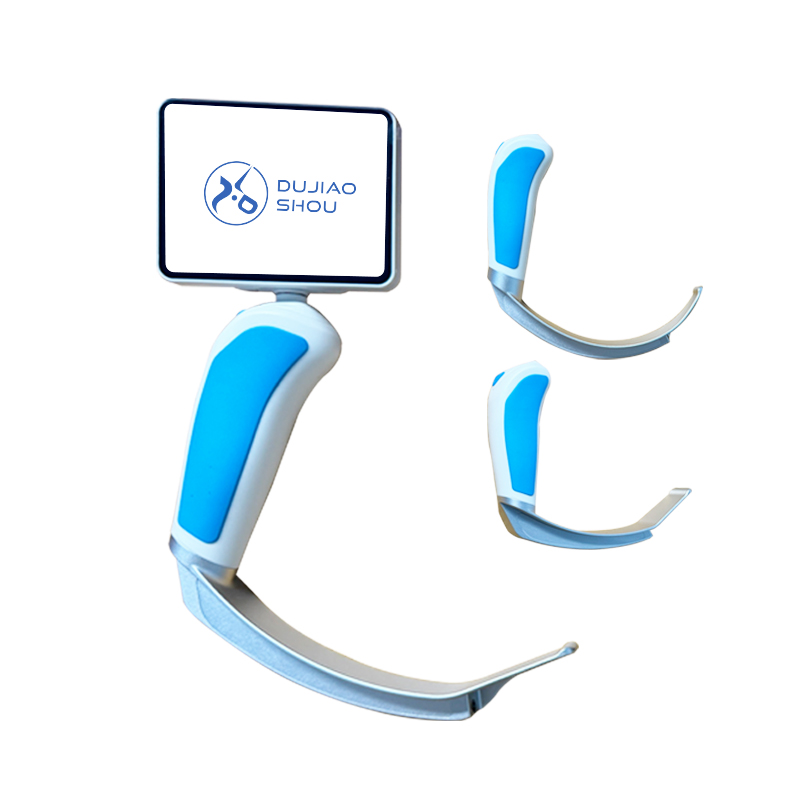
A modern video laryngoscope is a system of integrated components, each playing a critical role.
This is the part that enters the patient's airway and is the frontline of the device's function.
- Camera Module: The heart of the system. It typically contains a miniaturized CMOS or CCD image sensor, capable of capturing high-definition video (often 720p or 1080p). The sensor is protected behind a durable, optically clear lens.
- Light-Emitting Diodes (LEDs): Surrounding the camera are one or more high-intensity, white LEDs. They provide bright, cool, shadow-free illumination of the dark oropharyngeal cavity. Their placement is crucial to avoid glare from moist tissues.
- Blade Geometry: Blades come in two primary designs:
- Macintosh-style (Standard Geometry): Resembles a traditional curved blade. The camera is near the tip, but the curve is less extreme. It allows for both direct viewing (looking down the blade) and video viewing.
- Hyperangulated Geometry: Features a pronounced 60-90 degree curve. This design is specifically for indirect video viewing only. It excels at navigating around the tongue to view an anterior larynx but requires different tube delivery techniques.
- Heating Element (Anti-Fogging): A critical feature. The lens can fog upon entering the warm, humid airway. Many video laryngoscopes incorporate a small heating element around the lens that activates upon power-up, keeping the lens temperature above the dew point to prevent condensation.
The handle houses the "brain" and power source of the video laryngoscope.
- Power Source: Typically a rechargeable lithium-ion battery pack, providing power for the camera, LEDs, heating element, and display.
- Processing Unit: A small, onboard computer chip. It performs several key functions:
- Image Processing: It applies real-time algorithms to the raw video signal. This can include noise reduction (to clear up a grainy image), edge enhancement (to sharpen the outlines of anatomical structures), color correction, and anti-fog digital processing (a software backup to the physical heater).
- Signal Management: It formats the video signal for transmission to the display.
- Control Interface: Buttons (e.g., power, image capture/video recording) are often located on the handle.
- Connection Port: For models with a separate monitor, a durable, sealed cable transmits power and data from the handle to the screen.
This is the user interface where visualization occurs.
- Integrated Displays: Found on portable, all-in-one units. A small, high-resolution LCD or OLED screen is attached to the handle. This offers excellent portability and simplicity.
- Separate Cart/Stand-Mounted Monitors: Used in operating rooms. These larger screens (often 4-7 inches) provide a bigger, clearer image and may be part of a workstation that includes recording capabilities.
- Wireless Connectivity: An advanced feature in some models. The video laryngoscope transmits the video signal via Wi-Fi or Bluetooth to a separate tablet, smartphone, or hospital monitor. This eliminates cables and allows for flexible positioning of the display.
- Recording and Documentation: Most systems allow for still image capture and video recording of the procedure for medical records, quality assurance, and teaching.
- Integration Capabilities: High-end systems can integrate with hospital networks or anesthesia workstations to export images/video directly to the patient's electronic health record (EHR).
Understanding how the device works in practice clarifies its integrated function:
1. Preparation and Power-Up: The operator attaches the desired blade to the handle and powers on the video laryngoscope. The heating element begins warming the lens, and the system performs a self-check. The display activates, showing a clear test image or live feed.
2. Insertion and Navigation: With the patient positioned, the video laryngoscope blade is inserted into the mouth, typically following the tongue's contour. The operator's eyes are on the screen from the start, using the real-time video to navigate past the tongue, uvula, and epiglottis. There is no need to contort the head or neck to achieve a direct line of sight.
3. Glottic Identification and Optimization: As the blade tip approaches the larynx, the vocal cords, arytenoid cartilages, and glottic opening come into view on the screen. The operator manipulates the handle to center and optimize this view, often with minimal lifting force compared to direct laryngoscopy.
4. Endotracheal Tube Delivery: This step differs based on blade type.
- With Standard Geometry Blades: The tube can often be introduced under direct sight or by watching the screen as it passes through the visualized cords, similar to traditional technique.
- With Hyperangulated Blades: The extreme curve means the tube's path is not straight from the mouth to the glottis. The operator must use a stylet (a rigid guide) to pre-shape the tube into a matching "hockey stick" curve. While watching the tube tip on the screen, the operator guides it around the bend and through the cords, often requiring a "follow-the-tube" technique where the view is of the tube itself rather than an open glottis.
5. Confirmation and Withdrawal: Once tube placement is confirmed (via capnography, chest rise, etc.), the video laryngoscope is gently withdrawn along the path of insertion. The procedure is often recorded for documentation.
The integrated function of a video laryngoscope provides several mechanistic advantages:
- Overcoming Anatomical Obstacles: By providing an indirect view, it effectively manages difficult airway predictors like limited mouth opening, large tongue, short neck, and limited neck mobility.
- Improved First-Pass Success Rate: The superior and more consistent glottic view directly translates to higher rates of successful intubation on the first attempt, a key metric for patient safety.
- Enhanced Ergonomics and Reduced Force: Operators can maintain a comfortable, upright posture. The required lifting force is generally lower, reducing the risk of dental trauma and soft tissue injury.
- Team Visualization and Training: The display allows the entire team (assistants, trainees) to see the procedure, improving communication, assistance, and educational value.
- Documentation: Built-in recording creates an objective record of the airway anatomy and the intubation, valuable for legal, quality improvement, and teaching purposes.
While highly effective, the video laryngoscope's operation has inherent considerations:
- Dependence on Technology: Device failure (dead battery, faulty camera, fogged lens) can occur. A backup direct laryngoscope must always be available.
- Learning Curve for Hyperangulated Blades: The tube delivery technique is different and must be practiced. Proficiency with direct laryngoscopy remains essential.
- Cost and Processing: The devices are capital-intensive, and the blades (especially disposable ones) and handles require meticulous cleaning, disinfection, and maintenance per manufacturer guidelines to ensure reliable function.
- Potential for Esophageal Intubation: A magnified view of the esophagus can be mistaken for the glottis by the inexperienced user. Continuous waveform capnography remains the gold standard for confirmation, not the video image alone.
The video laryngoscope works by seamlessly integrating advanced micro-optics, digital image processing, and ergonomic design to solve a centuries-old problem in medicine: obtaining a reliable view of the larynx. It functions not as a simple camera, but as a sophisticated imaging system that captures, processes, enhances, and displays a real-time view of the airway, effectively extending the clinician's vision around anatomical barriers. From the anti-fog heated lens at the blade tip to the image-enhancing algorithms in the handle and the final display on the screen, every component is engineered to achieve one goal: making the invisible visible. As this technology continues to evolve with features like augmented reality overlays and AI-guided placement, its core working principle of indirect video visualization will remain the foundation for a new standard of safety and efficacy in airway management. The video laryngoscope is a powerful demonstration of how medical visualization technology, when applied thoughtfully, can fundamentally improve clinical practice and patient outcomes.
Contact us to get more information!

No, it does not. Proficiency in direct laryngoscopy remains a fundamental and essential skill. The video laryngoscope is a powerful tool, but it is technology-dependent. Batteries can die, lenses can fog irreparably, and cameras can fail. In such emergencies, or in situations where a video laryngoscope is not available (e.g., certain field settings), the ability to secure an airway with a direct laryngoscope is critical. Furthermore, understanding the anatomy and mechanics of direct laryngoscopy informs better use of the video laryngoscope. They are complementary skills.
These hyperangulated blades are designed specifically to navigate around the base of the tongue to visualize an anterior larynx (a larynx that is positioned more forward in the neck), which is a common cause of difficult direct laryngoscopy. The sharp curve allows the camera tip to peer around the tongue's bulk without requiring the extreme head tilt and force needed to align axes with a straight blade. However, this design makes passing the tube more challenging, requiring a pre-shaped stylet and a different technique focused on guiding the tube tip on screen.
Video laryngoscopes employ a multi-layered defense against fogging:
1. Physical Heating: Most blades have a small heating element that warms the lens to body temperature or slightly above, preventing moisture condensation.
2. Anti-Fog Coatings: The lens itself often has a hydrophobic coating that repels water droplets.
3. Software Algorithms: Image processors can detect and digitally reduce the appearance of haze or fog in the video feed.
4. Technique: Some clinicians gently touch the blade tip to the patient's buccal mucosa (inside of the cheek) for a second before insertion. This warms the metal/plastic close to body temperature, reducing the thermal shock that causes fogging.
Yes, the video laryngoscope is highly versatile. For nasotracheal intubation, it provides an excellent view of the glottis through the mouth while the tube is passed via the nose, allowing visual guidance of the tube through the vocal cords. It is also used for procedures like foreign body removal from the upper airway, changing tracheostomy tubes, and teaching airway anatomy. Its utility extends beyond routine orotracheal intubation.
The core optical and lighting components function identically. The difference lies in construction and logistics:
- Disposable Blades: Are single-use, sterile, and made from lower-cost plastics. They are pre-assembled with a camera and LEDs. After use, the entire blade is discarded, guaranteeing sterility and eliminating reprocessing errors. They are often used with a reusable handle.
- Reusable Blades: Are made of durable stainless steel or high-grade plastic designed to withstand hundreds of sterilization cycles. They require meticulous cleaning and high-level disinfection or sterilization after each use according to strict protocols to prevent cross-contamination.
Functionally during the procedure, they work the same way, but the disposable option simplifies infection control at a higher per-use cost.
[1] https://www.ncbi.nlm.nih.gov/pmc/articles/PMC3668105/
[2] https://www.thoracic.org/professionals/clinical-resources/critical-care/clinical-education/airway/video-laryngoscopy.php
[3] https://www.apsf.org/article/evolution-of-airway-management-video-laryngoscopy/
[4] https://www.fda.gov/medical-devices/surgery-devices/laryngoscopes
[5] https://www.rcoa.ac.uk/safety-standards-quality/guidance-resources/airway-management-guidelines


