


Content Menu
● Raw Material Selection and Preparation
>> Fiber and Polymer Selection
>> Nonwoven Fabric Production Technologies
>> Material Testing and Quality Assurance
● Manufacturing Process: From Fabric to Finished Gown
>> Fabric Unwinding and Cutting
>> Seam Construction and Assembly
>> Quality Inspection During Production
● Specialized Manufacturing for Different Gown Types
>> Surgical Gowns vs. Isolation Gowns
● Sterilization and Final Processing
>> Sterilization Methods for Sterile Isolation Gowns
>> Quality Control and Final Testing
● Regulatory Framework and Standards Compliance
>> AAMI PB70 Classification System
● Environmental Considerations and Sustainability Innovations
>> Waste Management Challenges
>> Sustainable Manufacturing Initiatives
● Future Trends in Isolation Gown Manufacturing
>> Smart Manufacturing Technologies
>> Advanced Material Development
>> Customization and On-Demand Manufacturing
● Frequently Asked Questions (FAQ)
>> 1. What is the most common material used in disposable isolation gown manufacturing?
>> 2. How are the seams of isolation gowns made liquid-resistant?
>> 3. What is the difference between how disposable and reusable isolation gowns are manufactured?
>> 5. Are there environmentally friendly alternatives in isolation gown manufacturing?
The manufacturing process of isolation gowns represents a critical intersection of materials science, precision engineering, and stringent regulatory compliance to produce essential personal protective equipment (PPE) for healthcare and industrial applications. As demand for reliable protective barriers has surged globally, understanding how isolation gowns are made provides insight into their protective capabilities, quality variations, and appropriate applications. This comprehensive examination details the step-by-step manufacturing journey of isolation gowns, from raw material selection to final packaging, while exploring the technological innovations and quality standards that define this vital protective equipment category.

The manufacturing of isolation gowns begins with the careful selection of base materials, which determine the gown's fundamental properties including barrier protection, breathability, comfort, and cost. The most common materials include:
- Polypropylene (PP): The predominant material for disposable isolation gowns due to its excellent balance of fluid resistance, breathability, and cost-effectiveness. Polypropylene fibers are hydrophobic, providing inherent resistance to fluid penetration.
- Polyethylene (PE): Often used for cheaper, less breathable gowns, typically in the form of spunbond or film fabrics that provide good liquid barrier properties but limited comfort for extended wear.
- Polyester (PET): Sometimes blended with other fibers to enhance strength and durability, particularly in reusable isolation gowns.
- SMS (Spunbond-Meltblown-Spunbond): A composite nonwoven fabric consisting of three layers that combines the strength of spunbond polypropylene with the enhanced filtration and barrier properties of a meltblown middle layer.
The majority of disposable isolation gowns utilize nonwoven fabrics created through several distinct manufacturing processes:
Spunbond Process: This method involves extruding molten polymer through spinnerets to form continuous filaments, which are then drawn by air, laid onto a moving conveyor belt, and bonded together using heat, pressure, or chemical means. Spunbond fabrics offer good strength and breathability, making them suitable for lower-risk isolation gowns.
Meltblown Process: In this technique, molten polymer is extruded through tiny nozzles surrounded by high-velocity hot air, which attenuates the polymer streams into microfibers. These fibers are collected on a conveyor, forming a web with excellent filtration properties. Meltblown fabrics typically serve as the critical barrier layer in multi-layer isolation gown constructions.
SMS Composite Fabrication: The SMS manufacturing process combines spunbond and meltblown technologies in-line to create a three-layer composite: a spunbond layer for strength, a meltblown middle layer for enhanced barrier properties, and another spunbond layer for comfort. This composite represents the industry standard for moderate to high protection level isolation gowns.
Before entering production, raw materials undergo rigorous testing to ensure they meet specified standards for:
- Basis Weight: Mass per unit area, typically measured in grams per square meter (gsm)
- Tensile Strength: Resistance to tearing and breaking
- Hydrostatic Pressure Resistance: Ability to resist fluid penetration under pressure
- Breathability: Measured as moisture vapor transmission rate (MVTR)
- Linting Potential: Tendency to shed particles, which is critical in sterile environments
The manufacturing process begins with large rolls of nonwoven fabric being mounted on unwinding stations. The fabric is fed through tension control systems to ensure smooth, consistent movement through the production line. Automated cutting systems, typically using ultrasonic or die-cutting technology, precisely cut the fabric into predetermined patterns for different isolation gown sizes (small, medium, large, extra-large).
The cut fabric pieces are transported via conveyor systems to assembly stations where various seam techniques are employed:
Ultrasonic Welding: This technology uses high-frequency ultrasonic vibrations to create molecular bonds between fabric layers without needles, thread, or adhesives. Ultrasonic seams are particularly valuable for isolation gown manufacturing as they create liquid-tight bonds without creating perforations that could compromise barrier integrity.
Heat Sealing: Applied heat and pressure melt the polypropylene fibers at seam edges, fusing them together upon cooling. This method produces strong, fluid-resistant seams appropriate for critical areas of the isolation gown.
Sewing with Bound Seams: Some reusable or higher-grade disposable isolation gowns incorporate traditional sewing with synthetic threads, often combined with tape binding over the seam to maintain liquid barrier properties. This approach is more common in surgical gowns than standard isolation gowns.
Multiple components are integrated during the assembly process:
Neck and Waist Ties: Typically made from the same nonwoven material or from spunbond fabric, ties are attached using ultrasonic welding or heat sealing at reinforcement points. Some isolation gowns feature breakaway ties for quick removal.
Elastic Cuffs: For isolation gowns requiring closer wrist fitting, elastic bands are incorporated into sleeve ends using specialized attachment methods that maintain barrier integrity while allowing stretch.
Reinforcement Patches: Additional fabric layers may be added to high-stress areas such as shoulders and elbows to enhance durability, particularly for reusable isolation gowns.
Closure Systems: Beyond ties, some isolation gowns incorporate adhesive tapes, hook-and-loop fasteners (Velcro), or snaps for secure closure.
Throughout the manufacturing process, automated vision systems and manual inspections ensure quality standards are maintained:
- Seam Integrity Checks: Verification that all seams are complete and properly bonded
- Component Placement Verification: Ensuring ties, cuffs, and reinforcements are correctly positioned
- Dimensional Accuracy: Confirming the isolation gown meets specified size parameters
- Visual Defect Detection: Identifying holes, stains, or irregularities in the fabric
The manufacturing of disposable isolation gowns prioritizes efficiency, consistency, and cost-effectiveness through highly automated processes:
High-Speed Production Lines: Modern facilities can produce thousands of isolation gowns per hour using continuous flow manufacturing principles.
Minimal Material Handling: Automated systems minimize human contact with the product, reducing contamination risks and labor costs.
Bulk Packaging Orientation: Disposable isolation gowns are typically folded and packaged immediately after production, often in counts of 25, 50, or 100 per box.
Reusable isolation gowns require different manufacturing considerations:
Durable Material Selection: Typically woven fabrics like cotton-polyester blends treated with durable water repellent (DWR) finishes or laminated with waterproof membranes.
Enhanced Seam Construction: More robust seaming methods, including double-needle stitching with sealed seams, to withstand repeated laundering and sterilization cycles.
Design for Reprocessing: Considerations for how the isolation gown will withstand commercial laundering, including colorfastness, shrinkage control, and closure durability.
While both are protective garments, surgical gowns (a subset of isolation gowns) undergo more stringent manufacturing processes:
Critical Zone Reinforcement: Surgical gowns feature enhanced barrier protection in specific areas (front torso and sleeves from cuff to elbow) where contact with fluids is most likely.
Sterility Assurance: Surgical gowns are manufactured, packaged, and sterilized under controlled environments to maintain sterility until use.
AAMI Level Compliance: Manufacturing processes are specifically designed to achieve and verify compliance with AAMI PB70 fluid barrier levels appropriate for surgical applications.
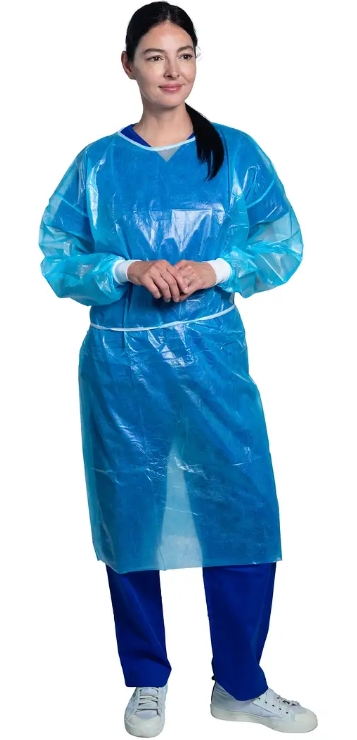
For isolation gowns marketed as sterile, several sterilization methods may be employed:
Ethylene Oxide (EtO) Sterilization: A low-temperature gas sterilization method suitable for heat-sensitive materials. The isolation gowns are packaged in breathable sterilization pouches, exposed to EtO gas under controlled conditions, then aerated to remove residual gas.
Gamma Radiation: High-energy gamma rays from cobalt-60 sources penetrate packaging materials to achieve sterilization without leaving chemical residues. This method is particularly effective for single-use isolation gowns.
Electron Beam (E-beam): Similar to gamma radiation but using accelerated electrons, offering faster processing times but with more limited penetration depth.
Final packaging serves multiple functions:
Maintaining Product Integrity: Packaging protects isolation gowns from environmental contamination, moisture, and physical damage during storage and transportation.
Sterility Maintenance: For sterile gowns, packaging must provide an effective microbial barrier while allowing penetration of sterilization agents.
User Information: Packaging includes essential information such as size, protection level, lot number, expiration date, and instructions for use.
Efficient Storage and Distribution: Packaging is designed to optimize space utilization in shipping containers and storage facilities while allowing easy identification of product types.
Before distribution, finished isolation gowns undergo final quality assurance procedures:
Lot Testing: Representative samples from each production lot are tested according to established protocols, which may include:
- Fluid Resistance Testing: Using standardized methods to verify the claimed AAMI protection level
- Tensile Strength Testing: Ensuring seams and fabric meet minimum strength requirements
- Biocompatibility Testing: For gowns contacting skin, ensuring materials don't cause irritation or allergic reactions
- Lint Generation Testing: Particularly important for surgical applications
Documentation and Traceability: Complete manufacturing records are maintained for each lot, enabling traceability from raw materials to finished product—a critical requirement for medical device regulations.
The Association for the Advancement of Medical Instrumentation (AAMI) PB70 standard establishes a classification system for liquid barrier performance of isolation gowns and other protective apparel:
Level 1: Minimal risk, for basic care or standard isolation with minimal fluid contact.
Level 2: Low risk, for procedures with minimal fluid exposure (e.g., suturing, blood draw from veins).
Level 3: Moderate risk, for procedures with moderate fluid exposure (e.g., arterial blood draw, inserting IV lines).
Level 4: High risk, for surgical procedures or scenarios with high fluid exposure.
Manufacturing processes are specifically designed and controlled to consistently produce isolation gowns that meet the requirements of their intended protection level.
In the United States, isolation gowns intended for medical use are regulated by the Food and Drug Administration (FDA) as Class I or Class II medical devices, depending on their intended use. Manufacturers must:
- Register their establishment with the FDA
- List their medical devices
- Comply with Quality System Regulation (QSR) requirements
- For surgical gowns, typically submit a 510(k) premarket notification
Manufacturers producing isolation gowns for global markets must consider additional standards:
- ISO Standards: Including ISO 13485 for quality management systems and specific product standards
- European CE Marking: Compliance with the Medical Device Regulation (MDR) for products sold in the European Union
- Other Regional Requirements: Specific standards in markets like China, Japan, and Australia
The disposable nature of most isolation gowns creates significant environmental concerns:
- Landfill Impact: Most disposable gowns are not biodegradable and contribute to landfill volume
- Energy and Resource Consumption: Manufacturing requires petrochemical feedstocks, water, and energy
- Carbon Footprint: From raw material production through manufacturing, distribution, and disposal
The industry is responding with various sustainability approaches:
Material Reduction: Designing isolation gowns that use less material while maintaining protection levels through advanced engineering and material science.
Recycled Content: Incorporating post-consumer or post-industrial recycled polymers into nonwoven fabrics where regulatory and performance requirements allow.
Biodegradable Alternatives: Developing materials from renewable sources like polylactic acid (PLA) derived from corn starch, though barrier performance and cost remain challenges.
Circular Economy Models: For reusable isolation gowns, implementing take-back and reprocessing programs to extend product lifecycles.
Manufacturers increasingly employ life cycle assessment (LCA) methodologies to evaluate and improve the environmental profile of isolation gowns across their entire lifespan—from raw material extraction to end-of-life disposal or recycling.
The future of isolation gown production includes increased integration of Industry 4.0 technologies:
Internet of Things (IoT) Sensors: Embedded in manufacturing equipment to monitor process parameters in real-time, enabling predictive maintenance and consistent quality control.
Artificial Intelligence and Machine Vision: Enhanced defect detection systems that learn from production data to identify increasingly subtle quality issues.
Digital Twins: Virtual replicas of manufacturing lines that simulate production scenarios to optimize efficiency and troubleshoot potential issues before they occur.
Ongoing research is expanding material options for isolation gowns:
Nanotechnology: Incorporating nanofibers or nanocoatings to enhance barrier properties while maintaining or improving breathability and comfort.
Antiviral and Antimicrobial Treatments: Developing fabrics with inherent pathogen-inactivating properties to provide additional protection beyond simple barrier function.
Phase Change Materials: Integrating materials that absorb and release heat to improve thermal comfort during extended wear.
Emerging trends point toward greater customization:
Size and Fit Personalization: Using body scan data to produce isolation gowns with improved ergonomics and protection for diverse user populations.
On-Demand Production: Digital printing and automated cutting systems enabling smaller batch production runs with reduced inventory requirements.
Application-Specific Designs: Tailoring gown features for particular clinical scenarios or user preferences while maintaining protection standards.
The manufacturing of isolation gowns is a sophisticated process that transforms raw polymers into essential protective equipment through precisely controlled steps of material production, cutting, assembly, and finishing. From the creation of nonwoven fabrics via spunbond and meltblown technologies to the application of ultrasonic welding for seam integrity, each stage of production is optimized to balance protection, comfort, and cost. The industry operates within a rigorous regulatory framework that classifies gowns according to their fluid barrier performance, with manufacturing processes specifically designed to meet AAMI PB70 levels appropriate for different risk scenarios. As environmental concerns grow, manufacturers are innovating with sustainable materials and processes while maintaining the critical protective functions that make isolation gowns indispensable in healthcare and other settings. Looking forward, advances in smart manufacturing, nanotechnology, and customization promise to further enhance the performance, sustainability, and user experience of these vital protective garments. Understanding how isolation gowns are made provides valuable insight into their appropriate selection and use, ultimately contributing to more effective infection control practices across diverse applications.
Contact us to get more information!
The most common material for disposable isolation gowns is polypropylene, typically in nonwoven form. Polypropylene is favored for its excellent balance of fluid resistance, breathability, and cost-effectiveness. It is often processed using spunbond or SMS (Spunbond-Meltblown-Spunbond) technologies to create fabrics with specific barrier properties. The SMS composite, consisting of three layers, provides enhanced protection and is widely used for isolation gowns requiring moderate to high fluid resistance.
The seams of isolation gowns are made liquid-resistant through specialized bonding techniques that avoid creating needle holes. The most common method is ultrasonic welding, which uses high-frequency vibrations to melt and bond the polypropylene fibers at the seam interface without perforating the material. Heat sealing is another technique that uses controlled temperature and pressure to fuse fabric layers together. These methods create continuous, monolithic bonds that maintain the garment's barrier integrity at seam locations.
Disposable isolation gowns are typically made from nonwoven polypropylene using highly automated, high-speed production lines focused on efficiency and cost-effectiveness. Reusable isolation gowns are generally constructed from woven fabrics (like cotton-polyester blends) that undergo durable water repellent (DWR) treatments. Their manufacturing involves more traditional sewing techniques with reinforced seams designed to withstand repeated laundering and sterilization cycles. The production of reusable gowns emphasizes durability and long-term performance rather than maximum production speed.
Manufacturers ensure isolation gowns meet specific AAMI PB70 protection levels through controlled material selection, precise manufacturing processes, and rigorous testing. The fabric is tested for fluid resistance using standardized methods that simulate clinical conditions. The entire manufacturing process—from fabric production to seam construction—is designed and monitored to consistently achieve the required barrier performance. Finished gowns from each production lot undergo quality control testing to verify they meet the claimed protection level before distribution.
Yes, several environmentally friendly alternatives are being developed in isolation gown manufacturing. These include gowns made from biodegradable materials like polylactic acid (PLA) derived from renewable resources, incorporation of recycled content into polypropylene nonwovens, and designs that use less material without compromising protection. For reusable gowns, improvements in durability and laundering efficiency reduce environmental impact over the product lifecycle. However, balancing sustainability with the necessary barrier protection, regulatory requirements, and cost remains an ongoing challenge for the industry.
[1] https://www.fda.gov/medical-devices/personal-protective-equipment-infection-control/isolation-gowns
[2] https://www.cdc.gov/niosh/npptl/topics/protectiveclothing/default.html
[3] https://www.astm.org/Standards/F2407.htm
[4] https://www.aami.org/docs/default-source/standards-library/ansi-aami-pb70-2012-r2020.pdf
[5] https://www.edana.org/nw-related-industry/nonwovens/nonwovens-processes
[6] https://www.iso.org/standard/56654.html


