
Views: 222 Author: Lake Publish Time: 2026-02-19 Origin: Site


Content Menu
● The Fundamental Architecture of Disposable Isolation Gowns
>> Primary Structural Components
● Nonwoven Fabrics: The Foundation of Disposable Gowns
>> Polypropylene: The Workhorse Material
>> SMS: Spunbond-Meltblown-Spunbond Technology
>> Material Weights and Specifications
● Polymer Films and Laminates for Enhanced Protection
>> Advanced Composite Structures
● Protection Levels and Material Requirements
>> ANSI/AAMI PB70 Classification
>> Viral Penetration Resistance
● Cuff Construction: The Critical Interface
>> Elastic and Other Cuff Types
● Regulatory Oversight and Quality Standards
>> FDA Classification and Oversight
>> International Standards Compliance
● Physical Performance Properties
>> Additional Performance Properties
● Sustainability Considerations and Material Innovations
>> Emerging Sustainable Materials
● The Integrated Protective System: Gowns and Medical Gloves
>> Creating a Continuous Barrier
● Frequently Asked Questions (FAQs)
>> 1. What is the most common material used in disposable isolation gowns?
>> 2. What does "SMS" mean in gown material specifications?
>> 3. How are the cuffs of isolation gowns constructed to work with medical gloves?
>> 4. What do the different AAMI protection levels mean for gown materials?
>> 5. Are disposable isolation gowns regulated as medical devices?
Disposable isolation gowns are essential protective garments worn by healthcare workers to prevent the transmission of infectious agents during patient care. While their role in infection control is widely understood, what actually goes into the construction of these gowns—the materials, layers, and components—is less commonly known. This article provides a comprehensive exploration of what disposable isolation gowns are made of, examining the nonwoven fabrics, polymer films, structural components, and quality standards that define these critical pieces of personal protective equipment (PPE).
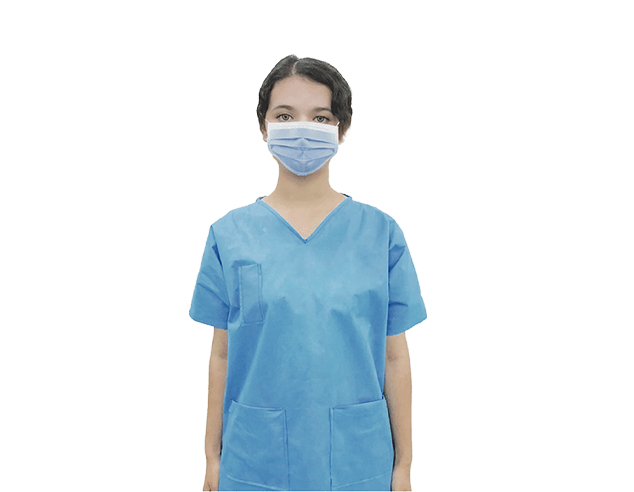
Disposable isolation gowns are single-use garments designed to protect healthcare workers' skin and clothing from contact with blood, bodily fluids, secretions, and infectious agents . Unlike reusable gowns, disposables are intended for one episode of patient care and then discarded. Their construction represents a carefully engineered balance between barrier protection, comfort, durability, and cost-effectiveness.
A complete disposable isolation gown consists of several key components:
- Body panel: The main garment covering the torso, typically composed of nonwoven fabric
- Sleeves: Long sleeves providing full arm coverage, often with specialized cuff construction
- Closures: Ties, snaps, or elastic components that secure the gown at the neck and waist
- Seams: The joined areas where fabric panels meet, critical points for barrier integrity
Each of these components must work together to create an effective protective barrier that also allows freedom of movement during patient care activities.
The vast majority of disposable isolation gowns are constructed from nonwoven fabrics—textile-like materials made from fibers bonded together through mechanical, chemical, or thermal processes rather than traditional weaving or knitting.
Polypropylene is the most common base material used in disposable isolation gowns . This thermoplastic polymer offers several advantages:
- Lightweight: Polypropylene fabrics are exceptionally light, typically measured in grams per square meter (gsm), reducing wearer fatigue during extended use
- Breathable: The material allows air and moisture vapor to pass through, improving comfort
- Fluid resistant: When appropriately manufactured, polypropylene provides effective resistance to liquid penetration
- Cost-effective: As a widely produced commodity plastic, polypropylene keeps gown costs manageable
A typical disposable isolation gown specification might list "polypropylene: 28 gsm" or similar fabric weights . This weight directly correlates with the gown's strength and protective capability.
SMS fabric represents an advanced nonwoven technology widely used in disposable isolation gowns . This three-layer structure consists of:
1. Spunbond outer layer: Provides strength and durability through continuous filaments
2. Meltblown middle layer: Offers filtration and barrier properties through microfibers that trap particles and resist liquid penetration
3. Spunbond inner layer: Adds comfort against the skin and additional strength
The SMS structure is particularly valued because it achieves excellent barrier properties without lamination, maintaining breathability while providing protection. Variations include SMMS (Spunbond-Meltblown-Meltblown-Spunbond) for enhanced barrier performance .
The material density, measured in grams per square meter (gsm), is a critical specification for disposable isolation gowns:
- Minimum standards: International procurement specifications often require minimum densities of 20-30 gsm
- Typical range: Common disposable gowns range from 25 to 45 gsm, depending on the protection level required
- Example specification: One product lists "42 gsm ± 3" total fabric weight for a laminated polypropylene-polyethylene gown
Higher gsm generally indicates greater material thickness, strength, and barrier protection, but also reduced breathability and increased cost.
For applications requiring higher levels of fluid protection, polymer films are incorporated into gown construction.
Polyethylene serves several roles in disposable isolation gowns :
- As a coating: Applied to polypropylene or other base fabrics to create an impermeable barrier
- As a film layer: Laminated between fabric layers to prevent liquid strike-through
- As microporous membranes: Engineered with microscopic pores that allow vapor transmission while blocking liquid penetration
A product specification might describe "laminated fabric" with "polyethylene: 15 gsm" combined with polypropylene, creating a gown suitable for higher-risk procedures where significant fluid exposure is anticipated .
Research has demonstrated sophisticated composite constructions for enhanced performance. One study developed dual-layer surgical gown fabrics consisting of :
- SMS nonwoven fabric laminated with microporous polyethylene film
- SMS nonwoven fabric laminated with thermoplastic polyurethane film
These composite fabrics offer outstanding breathability while providing superior liquid barriers according to the Association for the Advancement of Medical Instrumentation (AAMI) PB70 classification .
The study found that produced composite fabrics had no wet bacterial penetration of Staphylococcus aureus, contributing to the prevention of pathogen transfer during surgical procedures .
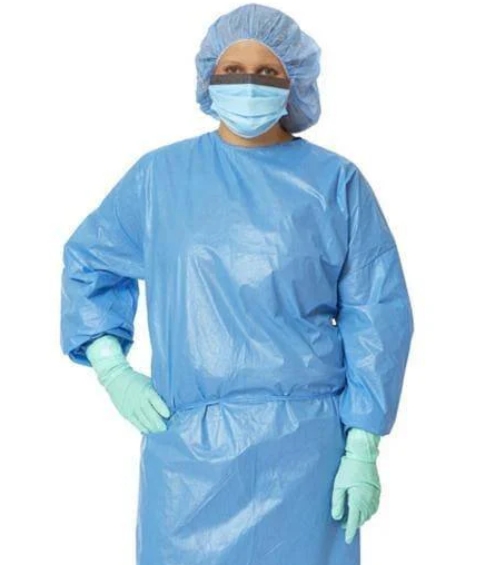
The American National Standards Institute (ANSI)/Association for the Advancement of Medical Instrumentation (AAMI) standard PB70 sets barrier requirements for gowns used for isolation and surgical purposes . This standard defines four classification levels based on material performance:
| AAMI Level | Protection Description | Material Requirements | Key Test Methods |
|---|---|---|---|
| Level 1 | Minimal risk, basic care | Basic nonwoven fabrics | Impact penetration (AATCC 42): ≤ 4.5 g |
| Level 2 | Low risk (blood draw, suturing) | SMS, light laminates | Impact: ≤ 1.5 g; Hydrostatic pressure (AATCC 127): ≥ 20 cm |
| Level 3 | Moderate risk (IV insertion, trauma) | SMMS, polyethylene-coated fabrics | Impact: ≤ 1.5 g; Hydrostatic pressure: ≥ 50 cm |
| Level 4 | High risk (fluid-intensive procedures, surgery) | Impervious laminates, reinforced films | Viral penetration testing (ASTM F1671/ISO 16604): No penetration |
The AAMI PB70 standard references specific AATCC test methods for determining liquid barrier protection classification . AATCC TM42 tests water resistance against impact penetration, while AATCC TM127 tests water resistance to hydrostatic pressure .
For Level 4 protection and some Level 3 applications, gowns must demonstrate resistance to viral penetration. Specifications require that the outer layer be viral penetration resistant material in critical areas (full front and arms), tested against viral penetration at a minimum pressure of 1.75 kPa .
The material must pass tests for resistance to penetration by blood-borne pathogens such as :
- ISO 16604:2004, at Class 2 or higher
- ASTM F1671
- Equivalent international standards
The gown cuff is a specialized component that must create a secure interface with medical gloves. Common cuff constructions include :
Sleeves are typically finished with double layer cuffs made from stretchy, interlocked jersey fabric. Specifications often require :
- Material: Cotton or synthetic knit
- Length: 4-8 cm
- Construction: Double layer for enhanced durability and secure fit
This knit cuff provides a snug fit around the wrist, allowing medical gloves to be pulled over the cuff to create a continuous barrier from the gown's body down to the glove fingertips.
Alternative cuff constructions include:
- Integrated elastic bands that maintain close contact with the skin or glove
- Thumb loops that secure the sleeve around the thumb, preventing sleeve migration during movement
The ties that secure isolation gowns must be strong enough to withstand movement during patient care. Gowns typically feature :
- Neck tie for secure fastening at the upper back
- Waist tie that binds at the back or front
- Reinforced attachment points where ties connect to the gown body
Seams are potential weak points where barrier integrity can be compromised. The ASTM F3352 standard for isolation gowns specifies requirements for seam strength and integrity . Seams must be constructed to maintain barrier performance under the stresses of movement during patient care.
The U.S. Food and Drug Administration (FDA) differentiates between non-surgical and surgical apparel :
- Non-surgical gowns (including isolation gowns): Class I medical devices subject to general controls (registration, listing, appropriate labeling, recordkeeping, good manufacturing practice)
- Surgical gowns: Class II medical devices requiring more rigorous 510(k) premarket notification with safety and efficacy data
As noted in regulatory guidance, the number of disposable surgical gowns receiving FDA clearance has grown substantially—over 30 disposable surgical gowns received FDA clearance in 2022 alone .
Disposable isolation gowns must comply with relevant international regulations:
- EU Medical Devices Directive 93/42, Class I or Medical Device Regulation (EU) 2017/745, Class I
- EU Personal Protective Equipment Directive 89/686, Category I
- ISO 13485:2016 quality management system certification
Specific ASTM standards apply to isolation gowns :
- ASTM F3352/F3352M-23b: Standard for isolation gowns
- ASTM F2407/F2407M-23a: Standard for surgical gowns
These standards reference ANSI/AAMI PB70, include additional mandatory or optional properties, and specify conformity assessment programs .
Research evaluating the physical performance of disposable isolation gowns has identified significant variations based on fiber types and construction methods . Key strength properties include:
- Tensile strength: Measured via ASTM D5034, evaluates breaking strength
- Tearing strength: Measured via ASTM D5733, evaluates resistance to tear propagation
- Seam strength: Measured via ASTM D1683, evaluates integrity at joined areas
A study of 20 commercial and 2 experimental disposable isolation gowns found large variations in tensile, tear, and seam strength results due to differences in fibers and construction methods . The study also found a linear relationship between gowns' AAMI PB70 levels and their tensile strength .
Manufacturers may undertake testing for additional properties related to :
- Comfort: Breathability and moisture vapor transmission
- Durability: Resistance to abrasion and flex cracking
- Lint generation: Particularly important for certain controlled environments
- Flame spread: For specific applications where fire resistance is required
The substantial use of disposable isolation gowns raises environmental concerns. Research indicates that single-use disposable gowns constitute a significant percentage of landfilled PPE by weight. Under isolation procedures, healthcare systems dispose of numerous gowns per patient per day as municipal waste, consisting primarily of non-degradable synthetic polymer materials.
Recent innovations include:
- Compostable materials: Paper-based textiles with compostable functional coatings that can degrade under industrial composting conditions while meeting barrier standards
- Recycled content: Incorporation of recycled materials into nonwoven fabric production
- Bio-based polymers: Development of gown materials from renewable resources
Some manufacturers offer gowns made from PBAT+PLA (biodegradable polymer blends) that demonstrate significant degradation in controlled environments while maintaining compliance with applicable standards .
Disposable isolation gowns are designed to integrate seamlessly with other PPE components, particularly medical gloves. The gown cuff must accommodate the glove cuff, allowing the glove to be pulled over the gown sleeve to create a continuous barrier . This interface prevents skin exposure at the wrist—a common site for contamination during patient care.
The gown's front panels and arms, which face the patient during care, are designated as "critical zones" requiring the highest level of barrier protection. Specifications often require that the outer layer be viral penetration resistant material in these critical areas . This targeted protection approach optimizes both safety and comfort.
Disposable isolation gowns are sophisticated medical devices constructed from engineered materials carefully selected for their protective capabilities, comfort, and cost-effectiveness. The primary materials—polypropylene, polyethylene, SMS nonwovens, and multi-layer laminates—each offer specific advantages for different clinical applications. These materials are combined with specialized components including double-layer knit cuffs, ties, and reinforced seams to create a complete protective garment.
The materials that constitute isolation gowns are rigorously tested to meet standardized performance levels defined by ANSI/AAMI PB70, with each level requiring specific barrier capabilities from impact resistance to viral penetration protection. Regulatory oversight by agencies including the FDA ensures that gowns meet quality and safety standards appropriate for their intended use.
Importantly, isolation gowns are designed to work in concert with other PPE, particularly medical gloves, to create a complete protective barrier. The interface between gown cuff and glove is a critical point where proper material selection and design prevent exposure.
As environmental concerns about PPE waste grow, innovative materials—including compostable textiles and gowns made from recycled content—are emerging to address sustainability challenges while maintaining the rigorous barrier performance that patient and provider safety demand. These material innovations, coupled with thoughtful procurement decisions, will shape the future of disposable isolation gowns and their role in comprehensive infection prevention strategies.
Contact us to get more information!
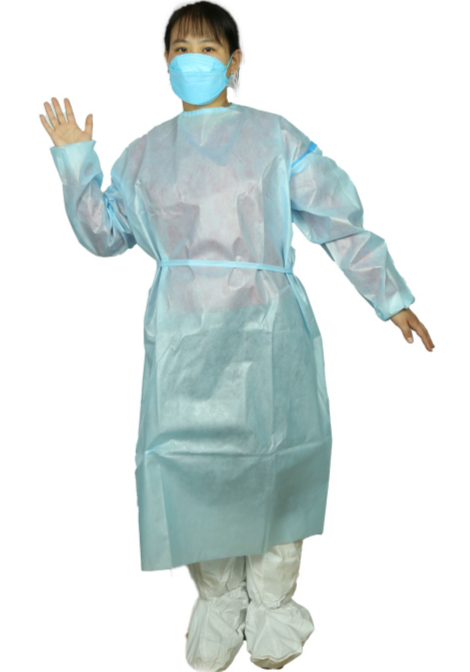
The most common base material is polypropylene, a lightweight, breathable thermoplastic polymer . It is often used alone for lower-protection gowns or combined with polyethylene coatings or SMS (Spunbond-Meltblown-Spunbond) construction for higher barrier requirements. A typical gown might specify polypropylene at 28 gsm fabric weight .
SMS stands for Spunbond-Meltblown-Spunbond, a three-layer nonwoven fabric structure . The outer spunbond layers provide strength and durability, while the inner meltblown layer (composed of microfibers) provides filtration and barrier properties against liquids and particles. SMMS (Spunbond-Meltblown-Meltblown-Spunbond) offers enhanced barrier performance.
The sleeves are typically finished with double layer knit cuffs made from stretchy, interlocked jersey fabric (cotton or synthetic) measuring 4-8 cm in length . This knit cuff provides a snug fit around the wrist, allowing medical gloves to be pulled over the cuff to create a continuous protective barrier from the gown's body down to the glove fingertips.
The ANSI/AAMI PB70 standard defines four levels based on material barrier performance :
- Level 1: Basic nonwoven fabrics for minimal risk; passes impact penetration test (≤4.5 g)
- Level 2: SMS or light laminates for low risk; passes impact (≤1.5 g) and hydrostatic pressure (≥20 cm)
- Level 3: SMMS or polyethylene-coated fabrics for moderate risk; passes impact (≤1.5 g) and higher hydrostatic pressure (≥50 cm)
- Level 4: Impervious laminates or reinforced films for high risk; passes viral penetration testing (ASTM F1671/ISO 16604)
Yes. In the United States, non-surgical isolation gowns are regulated as Class I medical devices subject to general controls (registration, listing, labeling, good manufacturing practice) . Surgical gowns are Class II medical devices requiring more rigorous 510(k) premarket notification . Internationally, they must comply with EU Medical Device Regulation or equivalent standards .
[1] https://supply.unicef.org/s0305139.html
[2] https://eureka-patsnap-com.libproxy1.nus.edu.sg/patent-US11452320B2
[3] https://www.ncbi.nlm.nih.gov/books/NBK607929/?report=reader


