
Views: 222 Author: Lake Publish Time: 2026-01-12 Origin: Site


Content Menu
● Introduction: A Window into the Lungs
● Core Components and How It Works
>> 2. The Fiberoptic System: The Heart of the Device
● The Bronchoscopy Workstation: The Supporting Ecosystem
>> 2. Therapeutic Applications
● The Evolution: From Fiberoptic to Video Bronchoscope
● The Legacy and Current Role of the Fiberoptic Bronchoscope
● Frequently Asked Questions (FAQ)
>> 1. What is the main difference between a fiberoptic and a video bronchoscope?
>> 2. Are fiberoptic bronchoscopes still used today?
>> 3. Why do images from a fiberoptic bronchoscope sometimes have black dots or lines?
>> 4. Can you record a procedure with a fiberoptic bronchoscope?
>> 5. How are fiberoptic bronchoscopes cleaned and disinfected?
In the intricate landscape of pulmonary medicine and critical care, the ability to directly visualize the intricate branching network of the tracheobronchial tree has revolutionized diagnosis and treatment. The fiberoptic bronchoscope represents a foundational milestone in this journey—a flexible, maneuverable instrument that became the workhorse of pulmonology for decades. While digital video technology is now prevalent, understanding the fiberoptic bronchoscope is essential to grasp the principles of modern bronchoscopy. This article provides a comprehensive exploration of the fiberoptic bronchoscope, detailing its design, working principles, applications, and its enduring legacy in the era of digital imaging.

A fiberoptic bronchoscope is a flexible endoscopic instrument specifically designed for the examination, diagnosis, and treatment of conditions within the airways (trachea, bronchi, and bronchioles). Its defining characteristic is its use of coherent fiberoptic bundles to transmit light into the lungs and an image back to the eyepiece. Introduced in the late 1960s, it offered unprecedented, minimally invasive access to the lower respiratory tract, replacing the need for rigid bronchoscopy in most diagnostic scenarios. For generations of pulmonologists, the fiberoptic bronchoscope was the primary tool for navigating the bronchial maze.
The genius of the fiberoptic bronchoscope lies in its mechanical and optical design, integrating several key systems into a single, flexible tube.
This is the long, flexible portion inserted into the patient. It contains all functional components and is covered in a smooth, biocompatible polymer sheath. Its flexibility is derived from a spiral steel band or mesh construction, allowing it to bend without kinking.
This system comprises two distinct bundles of hair-thin, flexible glass fibers, each with unique properties.
- Illumination Bundle: This bundle transmits cold light from an external light source (a high-intensity lamp in a bronchoscopy workstation) down the scope to illuminate the dark airways. The fibers in this bundle are incoherently packed; their arrangement does not need to be ordered.
- Image Bundle: This is the critical component. It consists of thousands of precisely aligned, coherent glass fibers. Each fiber acts as a discrete pixel. The arrangement of fibers at the distal (patient) end is exactly mirrored at the proximal (eyepiece) end. Light reflecting off the bronchial wall enters the distal tips of these fibers and is transmitted via total internal reflection to the eyepiece, where the clinician sees a mosaic image composed of the light from each individual fiber. The greater the number of fibers, the higher the resolution of the image.
Held by the operator, this section houses:
- Eyepiece: The clinician views the fiberoptic image directly here. It often includes a diopter adjustment ring for focus.
- Angulation Control Levers: These move cables running the length of the insertion tube, allowing the operator to deflect the distal tip up/down and, in some models, left/right. This active articulation is essential for navigating branchings.
- Instrument/Suction Channel: A working channel runs the length of the scope. It allows for the passage of biopsy forceps, brushes, needles, or suction catheters. It also enables the instillation of local anesthetics or saline.
This cable connects the control section to the bronchoscopy workstation, carrying the fiberoptic bundles to the light source and, if present, providing an attachment for suction.
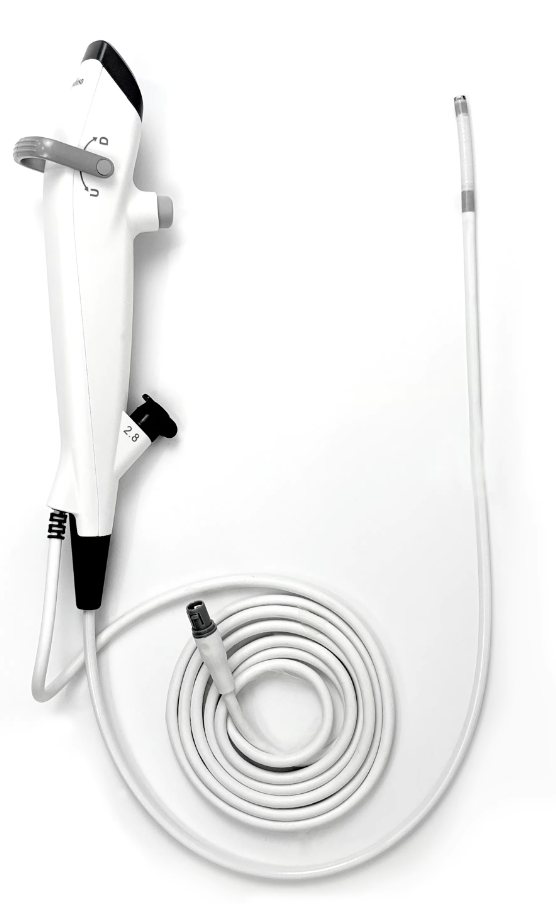
A fiberoptic bronchoscope does not operate in isolation. It is part of a bronchoscopy workstation, which typically includes:
- A High-Intensity Light Source: Provides the powerful, cool light for the illumination bundle.
- Suction Unit: For clearing secretions and blood.
- Monitoring Equipment: For patient vitals during the procedure.
- Ancillary Tools: Biopsy instruments, specimen traps, and camera attachments.
The fiberoptic bronchoscope enabled a wide range of diagnostic and therapeutic interventions:
- Visual Inspection: Evaluating airway anatomy, identifying tumors, inflammation, strictures, foreign bodies, or signs of infection.
- Bronchoalveolar Lavage (BAL): Infusing and suctioning saline to collect cellular and microbial samples from the alveoli for lab analysis.
- Transbronchial Biopsy (TBBx) and Endobronchial Biopsy: Using forceps passed through the working channel to obtain tissue samples from the lung parenchyma or airway walls.
- Transbronchial Needle Aspiration (TBNA): Using a needle to sample lymph nodes or masses adjacent to the airways.
- Removal of Secretions or Foreign Bodies: Using suction or specialized graspers.
- Airway Stent Placement: For maintaining patency in narrowed airways.
- Control of Hemorrhage: Applying topical agents or using balloon tamponade.
- Assisted Intubation: Guiding endotracheal tube placement in difficult airways.
Advantages (Historic and Lasting):
- Flexibility and Maneuverability: Allowed access to subsegmental bronchi unreachable by rigid scopes.
- Patient Comfort: Could be performed under conscious sedation rather than general anesthesia in many cases.
- Integrated Working Channel: Enabled simultaneous visualization and intervention.
- Durability: Well-maintained fiberoptic bronchoscopes have a long operational life.
Limitations (Driving the Shift to Digital):
- Image Quality: The fiberoptic image is a mosaic, giving a slightly pixelated, "honeycomb" appearance. Resolution is limited by the number of fibers (typically 10,000-50,000), far less than a digital sensor's megapixels.
- Susceptibility to Damage: Individual fibers can break if the scope is mishandled, causing black dots or lines in the image that cannot be repaired.
- Ergonomics: The clinician must look directly into the eyepiece, often in an awkward position, and cannot easily share the live view with others in the room.
- Difficulty Documenting: Recording the procedure required attaching a bulky external camera to the eyepiece, degrading image quality.
The limitations of fiberoptic imaging led directly to the development of the video bronchoscope (or videoscope). This next-generation device replaces the fiberoptic image bundle with a miniaturized charge-coupled device (CCD) or complementary metal-oxide-semiconductor (CMOS) digital camera chip at the distal tip. The image is transmitted electronically to a medical image processor and displayed on a high-resolution monitor.
Key Improvements with Video Technology:
- Superior Image Quality: Higher resolution, better color fidelity, and digital magnification.
- Improved Ergonomic: The operator views a comfortable monitor.
- Enhanced Education & Collaboration: The entire team can view the procedure live.
- Integrated Recording & Imaging: Seamless capture of still images and video for records and telemedicine.
- Advanced Imaging Modes: Compatibility with narrow-band imaging (NBI) or autofluorescence bronchoscopy (AFB).
Many modern bronchoscopy workstations are designed to support both older fiberoptic bronchoscopes (with a light source) and new video scopes (with a medical image processor).
While video bronchoscopy is now the standard for most new purchases, the fiberoptic bronchoscope is not obsolete.
- Cost-Effectiveness: They remain a lower-cost option for clinics with budget constraints, especially for basic diagnostic procedures.
- Backup and Specialized Use: Many units keep fiberoptic scopes as backups. Their thinner insertion tubes (due to no distal camera) can sometimes access tighter spaces.
- Disposables and Hybrids: The principles of fiberoptic light transmission are still used in some low-cost, disposable bronchoscopes intended for single-use in ICU settings to reduce infection risk, though many disposables now also use digital sensors.
The fiberoptic bronchoscope is a landmark achievement in medical technology that unlocked the interior of the living lung for routine clinical practice. Its ingenious use of coherent fiberoptic bundles to transmit light and images through a flexible, steerable tube defined pulmonary endoscopy for over three decades. While its limitations in image quality, ergonomics, and durability have driven the widespread adoption of superior digital video bronchoscope systems integrated with advanced medical image processors, the fiberoptic bronchoscope established the essential paradigm of flexible airway navigation and intervention. Understanding its design and function provides crucial historical context and underscores the continuous trajectory of innovation in medical visualization—a trajectory that companies like ours continue to advance through OEM partnerships, developing ever-more sophisticated tools for diagnosis and healing.
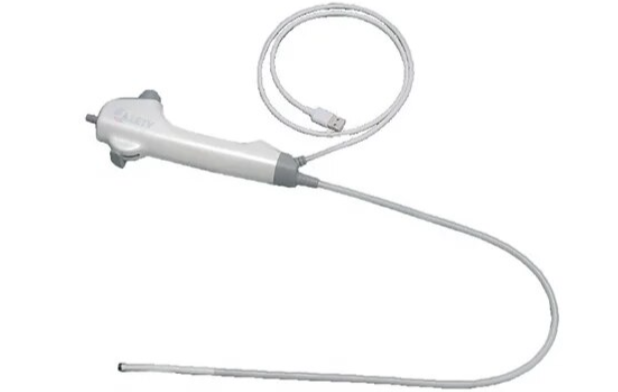
The core difference is in image transmission. A fiberoptic bronchoscope uses bundles of flexible glass fibers to optically transmit a mosaic image from the tip to an eyepiece. A video bronchoscope has a tiny digital camera sensor (CCD/CMOS) at its tip that captures an electronic image, which is then sent to a medical image processor and displayed on a monitor. Video scopes offer higher resolution, better ergonomics, and easier documentation.
Yes, but their use is diminishing in favor of video technology. They are still found in resource-limited settings due to lower cost, used as backup instruments, or employed for specific tasks where their thinner profile (lacking a distal camera) might be advantageous. However, for most new procurements and in modern bronchoscopy workstations, video bronchoscopes are the standard of care.
These artifacts are caused by broken optical fibers within the coherent image bundle. Each fiber acts as a pixel. When it breaks, it no longer transmits light, resulting in a permanent black spot or line in the field of view. This damage usually occurs from mishandling, such as sharp bending, pinching, or impact. Unlike a digital scope, this damage is not repairable and degrades image quality until the bundle is replaced.
Recording is possible but less convenient and of lower quality compared to a video scope. It requires mounting an external video camera onto the eyepiece of the fiberoptic bronchoscope. This adds weight and can compromise ergonomics, and the recorded image is a second-generation copy of the already pixelated fiberoptic image. Video bronchoscopes have integrated, high-quality recording directly from the sensor.
They require meticulous reprocessing due to their complex, delicate internal channels. The process involves:
1. Point-of-Cleaning: Wiping the insertion tube.
2. Leak Testing: To ensure the waterproof sheath is intact.
3. Manual Cleaning: Brushing and flushing all channels with enzymatic detergent.
4. High-Level Disinfection (HLD): Immersing the scope in a chemical disinfectant (e.g., glutaraldehyde, peracetic acid) for a specific contact time.
5. Rinsing and Drying: Thorough rinsing with sterile water to remove toxic disinfectant residues, followed by forced-air drying to prevent microbial growth.
This labor-intensive process is a key driver for the adoption of disposable bronchoscopes in high-risk settings.
[1] https://www.ncbi.nlm.nih.gov/books/NBK448152/
[2] https://www.thoracic.org/patients/patient-resources/resources/fiberoptic-bronchoscopy.pdf
[3] https://www.fda.gov/medical-devices/reprocessing-reusable-medical-devices/information-assured-reprocessing-reusable-medical-devices-health-care-facilities
[4] https://www.aabr.org/education/bronchoscopy-education/
[5] https://www.chestnet.org/Guidelines-and-Resources/Guidelines-and-Consensus-Statements/Bronchoscopy
[6] https://www.rirc.org/resources/bronchoscopy/
[7] https://www.iso.org/standard/36404.html (Biocompatibility)
[8] https://www.cdc.gov/infectioncontrol/guidelines/disinfection/index.html
[9] https://journals.lww.com/borc/Fulltext/2018/01000/The_History_of_Bronchoscopy.1.aspx


