
Views: 222 Author: Lake Publish Time: 2025-12-28 Origin: Site


Content Menu
● Deconstructing the Term: "Transnasal Insertion"
● The Step-by-Step Technique of Transnasal Bronchoscope Insertion
● Clinical Rationale and Advantages of the Transnasal Route
● Considerations, Challenges, and Contraindications
● Comparison to Transoral Insertion
● The Role of the Bronchoscope Design
● Frequently Asked Questions (FAQ)
>> 1. Does transnasal bronchoscope insertion hurt?
>> 2. What happens if my nose is too blocked or narrow for the bronchoscope?
>> 3. Is there more risk of infection with a transnasal approach?
>> 4. Why would a doctor choose transoral over transnasal insertion?
>> 5. Can you perform a transnasal bronchoscopy on a patient with a broken nose?
In the detailed language of medical procedure notes and clinical reports, the phrase "the bronchoscope was inserted transnasally" is a precise descriptor of a common and deliberate approach to bronchoscopy. For patients, trainees, and professionals in allied fields, understanding this term is key to visualizing the procedural journey. "Transnasally" simply means "through the nose." Therefore, the statement describes a technique where the physician introduces the flexible bronchoscope into the patient's airway via the nasal passage, as opposed to through the mouth (transorally) or through an artificial airway like a tracheostomy. This article delves deeply into the meaning, methodology, clinical rationale, advantages, and considerations of the transnasal insertion of a bronchoscope, providing a comprehensive view of this fundamental airway access technique.
For a company specializing in the design and OEM manufacturing of medical visualization devices like bronchoscopes, understanding these procedural nuances is critical. It informs design choices regarding insertion tube diameter, flexibility, and distal tip ergonomics to facilitate smooth and comfortable transnasal passage.

The phrase can be broken down into its core components:
- Bronchoscope: The instrument – a flexible tube with a light and camera.
- Inserted: The action of introducing the instrument.
- Transnasally: The anatomic route – trans (through) *nasal* (the nose).
Thus, the complete path is: External environment → Nostril → Nasal Cavity → Nasopharynx → Oropharynx → Larynx (between the vocal cords) → Trachea → Bronchi. The bronchoscope navigates this natural anatomic corridor to reach its target.
Performing a transnasal insertion is a skilled maneuver that follows a logical sequence:
1. Patient Preparation and Positioning: The patient is typically placed in a semi-recumbent or supine position. Supplemental oxygen is often provided. Vital signs are monitored throughout.
2. Topical Anesthesia and Decongestion: This is a critical step for patient comfort and procedural success.
- Decongestion: A vasoconstrictor spray (e.g., phenylephrine) may be applied to the nasal mucosa to shrink the turbinates and widen the nasal passage, reducing the risk of bleeding and easing the bronchoscope's passage.
- Anesthesia: A local anesthetic (most commonly lidocaine) is administered. This is done via a nebulizer for the upper airway, followed by direct spray or gel applied to the nasal passages and the oropharynx. Additional "spray-as-you-go" anesthesia is delivered through the bronchoscope's working channel to anesthetize the larynx and trachea.
3. Selection of the Nasal Passage: The operator often examines both nostrils (anterior rhinoscopy) to select the more patent side, sometimes using a smaller-caliber nasopharyngeal airway as a preliminary guide or dilator.
4. The Insertion Maneuver:
- The tip of the bronchoscope is lubricated with a sterile, water-soluble gel.
- The operator gently advances the bronchoscope along the floor of the chosen nasal cavity, under direct video guidance. The inferior meatus (the passage beneath the inferior turbinate) is the preferred path as it offers the widest and most direct route.
- The scope passes posteriorly through the nasopharynx, then curves downward into the oropharynx (behind the tongue).
- From the oropharynx, the tip is maneuvered to visualize the epiglottis and vocal cords. After confirming cord abduction during inspiration, the bronchoscope is gently passed between the cords into the trachea, completing the transnasal insertion phase. The examination of the bronchial tree then proceeds.
Choosing the transnasal approach is not arbitrary; it offers several distinct benefits:
- Patient Comfort and Cooperation: For awake or moderately sedated procedures, the transnasal route is often better tolerated. It avoids triggering the strong gag reflex associated with the posterior tongue, which is more stimulated during oral insertion. This can reduce the need for deep sedation.
- Stable and Direct Path: The nasal passages provide a natural, fixed conduit that helps stabilize the bronchoscope, minimizing unwanted movement in the oropharynx and offering a relatively direct line to the larynx.
- Avoids the Bite Risk: Transnasal insertion completely bypasses the teeth. This eliminates the risk of the patient biting and damaging the expensive bronchoscope, rendering a bite block unnecessary in most cases.
- Ideal for Specific Procedures: It is the standard approach for procedures targeting the upper airway, nasopharynx, and for passing instruments through the bronchoscope that require a stable, straight-line approach.
- Facilitates Nasal Endotracheal Intubation: When bronchoscopy is used to guide the placement of a nasotracheal tube, the bronchoscope acts as a direct visual stylette, sliding through the nose alongside or inside the tube.
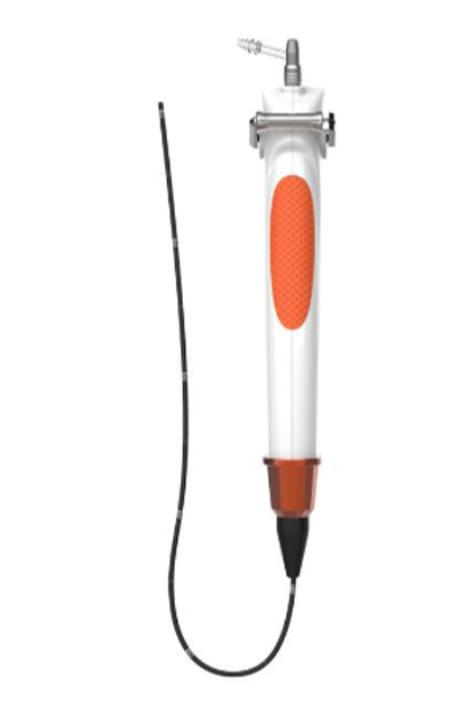
While advantageous, the transnasal route is not suitable for every patient or situation.
- Anatomical Constraints: Nasal septum deviation, hypertrophic turbinates, nasal polyps, or previous nasal surgery can create obstruction, making passage difficult or impossible and increasing the risk of mucosal trauma and bleeding.
- Bleeding Risk: The nasal mucosa is highly vascular. Even with decongestion, minor epistaxis (nosebleed) is a common, though usually self-limiting, occurrence. It is contraindicated in patients with significant coagulopathy.
- Scope Diameter: The nasal passage limits the outer diameter of the bronchoscope that can be used. Larger therapeutic bronchoscopes with bigger working channels may not fit transnasally and often require a transoral approach.
- Infection Control: The nose is not sterile. While the bronchoscope will be cleaned and disinfected afterwards, there is a theoretical (though low) risk of introducing nasal flora into the lower airways, which is a consideration in immunocompromised patients.
- Relative Contraindications: Include recent nasal trauma, CSF rhinorrhea (leak of cerebral spinal fluid), and severe obstructive sleep apnea where nasal obstruction is a known issue.
Understanding "transnasal" is enhanced by contrasting it with the alternative primary route:
| Feature | Transnasal Insertion | Transoral Insertion |
|---|---|---|
| Route | Through the nose. | Through the mouth. |
| Gag Reflex | Less stimulated. | More stimulated; requires good topical anesthesia. |
| Bite Risk | None. | Significant; requires a bite block. |
| Stability | More stable in upper airway. | Can be less stable in oropharynx. |
| Scope Size | Limited by nasal anatomy. | Can accommodate larger therapeutic bronchoscopes. |
| Common Use | Diagnostic bronchoscopy, awake procedures. | Therapeutic procedures, ICU intubations, use with larger scopes. |
The success of transnasal insertion is influenced by bronchoscope design. Key features for this route include:
- A Slim Outer Diameter: Typically 5.0-5.9mm for standard adult scopes, allowing passage through most nasal cavities.
- Optimal Flexibility and Torque Response: Allows the operator to navigate the nasal curves and make the turn from the nasopharynx to the oropharynx with precision.
- A Smooth, Lubricious Insertion Tube Coating: Minimizes friction and mucosal trauma.
- A Distal Tip with Appropriate Angulation: Enables the operator to "look around corners," such as directing the view downward from the nasopharynx.
The statement "the bronchoscope was inserted transnasally" encapsulates a specific, deliberate, and skillful technique central to flexible bronchoscopy. It defines the first segment of the instrument's journey, leveraging the nasal anatomy as a natural and stable port of entry to the respiratory tract. This approach prioritizes patient comfort and procedural stability for a wide range of diagnostic examinations.
The choice between transnasal and transoral insertion is a fundamental clinical decision, balancing patient anatomy, procedural goals, and bronchoscope capabilities. For the proceduralist, mastering the transnasal route—with its nuances of anesthesia, navigation, and troubleshooting—is an essential skill. For device manufacturers, understanding the demands of this approach is crucial for creating bronchoscopes that are not only powerful imaging tools but also adept at traversing the intricate gateway of the nasal cavity with minimal trauma. Ultimately, the transnasal insertion of the bronchoscope represents a perfect harmony of clinical acumen, patient-centered care, and engineered medical technology working in concert to illuminate the hidden pathways of the lung.

With proper topical anesthesia and sedation, the procedure should not be painful. Patients typically feel pressure and a sensation of needing to cough when the bronchoscope passes through the larynx, but not sharp pain. The nasal passage is numbed with spray/gel, and the throat is anesthetized. Discomfort is usually minimal, and many patients tolerate it very well under light sedation.
The physician will assess your nasal patency beforehand. If one side is too narrow, they may attempt the other side. If both are obstructed or the bronchoscope cannot pass safely, the physician will switch to the transoral route (through the mouth). This is a standard alternative, and the procedure then continues normally, just via a different entry point.
The risk of introducing a significant infection into the lungs via a transnasally inserted bronchoscope is extremely low. The bronchoscope passes through the non-sterile upper airway regardless of the route (nose or mouth). Standard bacteria from the nasopharynx are routinely aspirated during normal life. The bronchoscope itself is cleaned and high-level disinfected after every procedure. Immunocompromised patients are evaluated carefully, but the transnasal route is not universally contraindicated for them.
A doctor would choose a transoral insertion primarily when: 1) Using a larger therapeutic bronchoscope (for procedures like stent placement) that won't fit through the nose, 2) The patient has severe nasal obstruction or anatomy, 3) The procedure requires frequent removal and re-insertion of the scope or large instruments (the oral route is generally quicker for re-entry), or 4) In an emergency or intubated patient in the ICU where oral access is already established or more direct.
This requires extreme caution and is often a relative contraindication, especially in the acute setting. Inserting a bronchoscope through a recently fractured nose could worsen the injury, cause significant pain, or be technically impossible due to swelling and displacement of structures. The physician would likely delay the procedure if possible or opt for a transoral approach to avoid the injured area.
[1] https://www.ncbi.nlm.nih.gov/books/NBK448152/
[2] https://erj.ersjournals.com/content/50/3/1700429
[3] https://www.thoracic.org/professionals/clinical-resources/critical-care/clinical-education/bronchoscopy.php
[4] https://www.chestnet.org/Guidelines-and-Resources/Guidelines-and-Consensus-Statements/Bronchoscopy
[5] https://bronchoscopy.org/education/bronchoscopy-manual
[6] https://www.fda.gov/medical-devices/gastroenterology-urology-devices/bronchoscopes
[7] https://pubs.rsna.org/doi/full/10.1148/rg.2019180016
[8] https://www.atsjournals.org/doi/full/10.1164/rccm.201802-0286ST
[9] https://journals.lww.com/bronchology/Abstract/2004/03000/Transnasal_vs_Transoral_Insertion_of_the.4.aspx


