
Views: 222 Author: Lake Publish Time: 2025-12-26 Origin: Site


Content Menu
● The Nature of the Risk: Why Scalpel Blades Are Particularly Hazardous
● Regulatory Mandates: It's Not a Choice, It's the Law
● The Correct Procedure for Scalpel Blade Disposal
● Consequences of Improper Disposal
● The Role of Safety-Engineered Devices
● Frequently Asked Questions (FAQ)
>> 3. Are there different types of sharps containers for blades versus needles?
>> 4. What is the proper way to remove a scalpel blade if no blade remover is available?
>> 5. How full is "too full" for a sharps container containing blades?
In the meticulously regulated environment of surgical and procedural settings, the safe handling and disposal of medical sharps is a cornerstone of occupational safety. Among the most common and potentially dangerous sharps are scalpel blades. These razor-sharp disposable blade instruments are fundamental to surgical practice but pose a significant risk of percutaneous injury, which can lead to the transmission of bloodborne pathogens such as Hepatitis B, Hepatitis C, and HIV. A critical question that arises in every clinic, operating room, and laboratory is: Should scalpel blades be disposed of in the sharps container? The unequivocal and evidence-based answer is yes. This article provides a comprehensive examination of why the proper disposal of scalpel blades—specifically, every single disposable blade—into a designated sharps container is not just a recommendation but a mandatory safety protocol dictated by international regulations, infection control best practices, and the fundamental duty of care to healthcare workers and waste handlers.

To understand the imperative for correct disposal, one must first appreciate the unique hazard posed by a used scalpel disposable blade. Unlike a needle, which has a single sharp point, a scalpel blade possesses a long, continuous cutting edge. This design makes it exceptionally effective for surgery but also means it can cause severe lacerations. A disposable blade is contaminated with patient blood and tissue immediately upon use. A needle-stick injury is dangerous, but a scalpel laceration can be deeper, longer, and involve greater exposure volume, potentially increasing the risk of pathogen inoculation if the source patient is infected.
Furthermore, the small size and the common practice of detaching the disposable blade from a reusable handle create a high-risk moment. Fumbling with a loose blade or attempting to recap it (which is strictly prohibited) are frequent precursors to injury. The only way to mitigate this risk from the point of use to final disposal is through a rigid, standardized disposal pathway that eliminates handling of the exposed sharp.
The disposal of scalpel blades is not governed by institutional preference but by enforceable legal and regulatory standards. These frameworks universally classify used scalpel blades as regulated medical sharps waste.
- Occupational Safety and Health Administration (OSHA) Bloodborne Pathogens Standard (29 CFR 1910.1030): This is the cornerstone regulation in the United States. It explicitly requires that contaminated sharps be discarded immediately or as soon as feasible into containers that are puncture-resistant, leak-proof, closable, and labeled with a biohazard symbol. A scalpel disposable blade meets the definition of a contaminated sharp and must be placed in such a container. The standard also prohibits bending, recapping, or removing contaminated sharps unless no feasible alternative exists.
- International and National Guidelines: Similar stringent regulations exist worldwide. The World Health Organization (WHO) guidelines on healthcare waste management classify scalpel blades as "sharps waste" requiring disposal in safety boxes. The European Union's directives, along with national health service protocols in the UK, Canada, Australia, and elsewhere, all mandate disposal in dedicated sharps containers.
Non-compliance with these regulations can result in substantial fines for healthcare facilities and, more importantly, demonstrates a failure to provide a safe workplace, leaving the institution liable in the event of an injury and subsequent infection.
Knowing that blades go into a sharps container is only the first step. The *how* is equally critical for safety. The following step-by-step procedure is considered best practice:
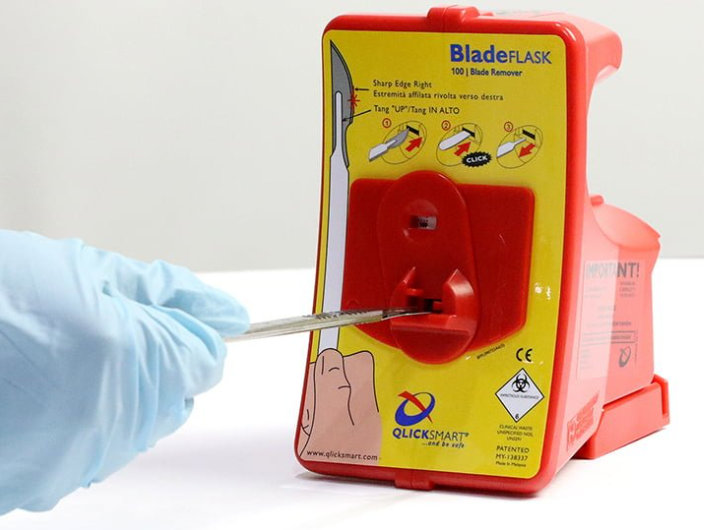
1. Use a Single-Handed Scoop Technique or a Dedicated Removal Device: Immediately after use, the disposable blade should be removed from the handle. This should never be done by hand. The safest method is to use a blade remover—a device that securely grips the blade and allows it to be ejected directly into the nearby sharps container. Alternatively, if a remover is not available, the "scoop" technique can be used: place the opened sharps container on a stable surface, and using the handle, carefully scoop the blade off into the container without the fingers ever coming near the sharp edge.
2. Immediate Disposal into a Closable Sharps Container: The detached disposable blade must be placed immediately into a FDA-approved or standards-compliant sharps container. This container should be located as close as possible to the point of use (e.g., on the Mayo stand in an OR, on the procedure cart in a clinic).
3. Do Not Force or Overfill: Blades should be dropped in, not pushed. Never overfill a sharps container; it should be closed and replaced when it reaches the designated fill line (typically ¾ full). An overfull container prevents safe closure and increases the risk of spillage and injury during handling.
4. Secure Final Disposal: Once sealed, the full sharps container is treated as regulated medical waste and must be disposed of according to local regulations, typically through incineration or other approved treatment methods that ensure complete destruction of pathogens.

The failure to dispose of a scalpel disposable blade correctly has a chain of negative consequences:
- Healthcare Worker Injury: The most immediate risk is to the person improperly handling the blade or to environmental services staff who may encounter a loose blade in general trash. This can lead to costly post-exposure prophylaxis, emotional distress, lost work time, and potential long-term illness.
- Waste Handler Injury: Sanitation workers are at severe risk if blades are placed in regular trash bags. A disposable blade can easily cut through a plastic bag, causing a potentially contaminated laceration.
- Environmental and Public Health Hazard: Improperly disposed sharps can end up in landfills or public spaces, posing a risk to the community, including children.
- Regulatory and Financial Penalties: Facilities found in violation of OSHA or other regulations face significant fines and damage to their reputation.
- Increased Liability: Any injury traceable to improper disposal exposes the facility to lawsuits and increased insurance costs.
To further reduce risk, the market has seen a rise in safety-engineered scalpel blades and handles. These are disposable blade systems designed with integrated safety features, such as:
- Retractable Blades: The blade retracts into the handle after use.
- Blade Shields: A shield slides over the blade edge after use, locking into place.
- Integrated Blade Removers: The handle itself incorporates a mechanism to safely remove and contain the blade.
While these devices represent a higher level of protection and are encouraged by OSHA's emphasis on engineering controls, the fundamental rule remains: even a safety-shielded disposable blade assembly must ultimately be disposed of as a sharp. The entire unit typically goes into the sharps container.
The question of whether scalpel blades should be disposed of in sharps containers admits no ambiguity. The answer is a resounding and non-negotiable yes. Every single disposable blade, upon completion of its use, must be immediately and safely placed into a designated, puncture-resistant sharps container. This mandate is rooted in the severe risk of bloodborne pathogen transmission, is enshrined in global occupational health regulations, and is a fundamental ethical obligation to protect healthcare workers, waste management personnel, and the public.
Adherence to this protocol requires more than just accessible containers; it requires a culture of safety supported by continuous training, the availability of safe removal tools like blade removers, and the potential adoption of safety-engineered devices. The momentary convenience of discarding a blade elsewhere is inconsequential compared to the lifelong consequences of a preventable sharps injury. In the high-stakes environment of healthcare, the correct disposal of a scalpel disposable blade is a simple yet profound act of professional responsibility and collective safety.
Yes, the entire unit—disposable blade and handle—should be disposed of as a single sharp item in the sharps container. It is considered a contaminated sharp assembly. Do not attempt to separate them; this increases handling risk. Many modern safety scalpels are designed as one-piece disposable blade units for this reason.
No, you should never recap a used scalpel blade. Recapping is a high-risk maneuver explicitly warned against in OSHA guidelines. It is a leading cause of sharps injuries. The blade should be removed at the point of use using a blade remover or the scoop technique and placed directly into the sharps container. If a container is not immediately at hand, one must be brought to the point of use.
Generally, standard FDA-approved sharps containers are designed to safely hold all types of medical sharps, including needles, scalpels, blades, and broken glass. They are tested to be puncture-resistant from both needles and blades. There is no need for a separate "blade-only" container; the key is to use a properly rated container and not overfill it.
The recommended alternative is the "scoop" technique:
1. Place the sharps container on a stable surface.
2. Hold the scalpel handle in one hand.
3. Carefully insert the tip of the blade into a slot in the sharps container lid (if designed for this) or use the edge of the container opening to catch the blade.
4. Gently lift and twist the handle so the blade is "scooped" off into the container, without your fingers ever touching the blade or being in the path of the sharp edge.
Immediately dispose of the handle if it is also contaminated or designated as single-use.
A sharps container should be closed and replaced when it is three-quarters (¾) full. This is a critical safety rule. An overfilled container prevents the lid from closing and locking securely. This can lead to blades or needles protruding, creating an extreme hazard for anyone handling the container during transport and disposal. Never force a blade into a full container.
[1] https://www.osha.gov/laws-regs/regulations/standardnumber/1910/1910.1030
[2] https://www.cdc.gov/sharpssafety/index.html
[3] https://www.who.int/publications/i/item/WHO-MCS-ESB-98.1
[4] https://www.fda.gov/medical-devices/general-hospital-devices-and-supplies/sharps-medical-devices
[5] https://www.ncbi.nlm.nih.gov/books/NBK554519/
[6] https://www.who.int/teams/environment-climate-change-and-health/water-sanitation-and-health/health-care-waste/sharps
[7] https://www.epa.gov/rcra/medical-waste
[8] https://www.osha.gov/sharps/solutions
[9] https://www.cdc.gov/niosh/topics/bbp/safer.html


